” AI is not another utility that needs to be regulated once it is mature. It is a powerful force, a new form of smart agency, which is already reshaping our lives, our interactions, and our environments. ” ( AI4People Scientific Committee )
What are these “SELF-DRIVING CARS”??
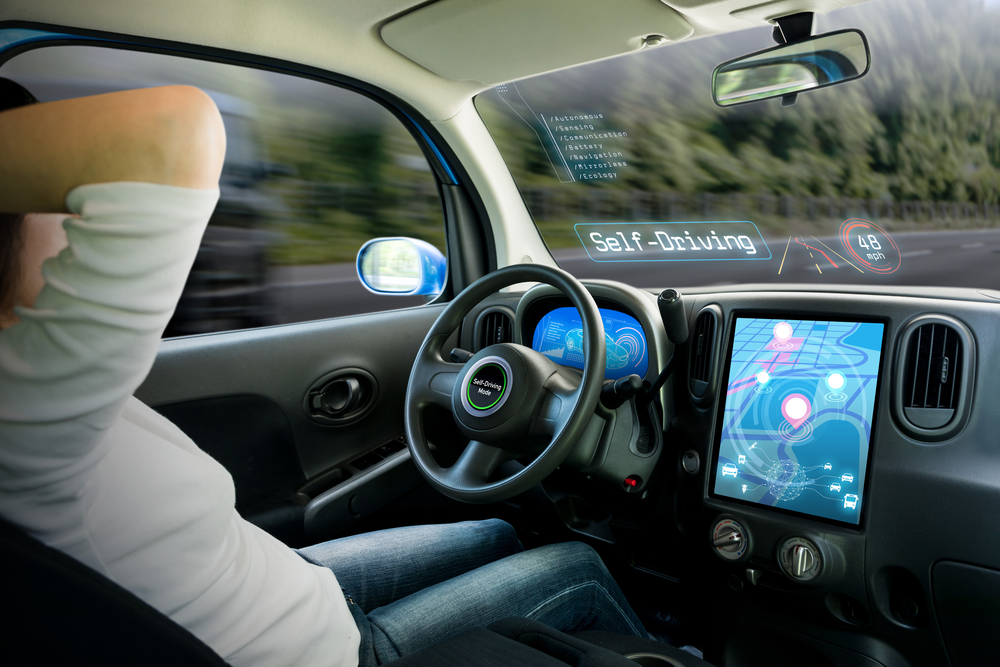
Driver less, self-driving cars or autonomous vehicles are coming.Introduced in back in 1977.The world’s eyes fell on them after the big techs started to experiment on them.It has become one of the most talked about topic in the academic field as well the tech industry as the technology evolved.There are a lot of people who has researched on this topics and released their own opinion on how these cars could be a gift and a curse to the human population.
Maxmen in 2018 said “Test versions of autonomous cars are cruising through several US cities. By 2021, at least five manufacturers hope to have self-driving cars and trucks in wide use. Some of the world’s biggest tech companies — including Google, Uber and Tesla — and car- makers now have self-driving-car programs.”Which is true , all the high tech companies are trying to make a change in the world with driver less cars.Profit is one goal too , with lesser driver to pay for the companies profit gets to be kept within.It can also reduce human errors while driving. That’s exactly what the road transport and road safety associations have to say “[T]he rush to bring self-driving vehicles (a complex and rapidly developing technology) to market may compromise consumer safety and autonomy… The publicly-expressed motivation for creating the technology is to improve road safety. Advocates typically present statistics on highway deaths (ASIRT 2017) and how human drivers are a significant cause of such accidents (NHTSA 2015), and then seek to make the case of how many lives self-driving cars could save (e.g., Setyon 2016).”
This is too good to be true !! A machine doing a humans work to reduce error ?? a machine built for human sophistication , does it really have no issues and accepted by all walks of the society.
Not all agree with a machine taking over the work done by a human who can think and act on their own like (Borenstein, Herkert & Miller, 2019) “[B]ut social scientists say the cars raise complex ethical issues.”
Who is responsible ?
Who’s responsible is the most asked question in any life situation.Even a maned car , when accident occur , the question “who’s responsible ?” is the main argument.There are people who sympathize with the driver there are people who sympathize with the person who crossed the road at the wrong time .When it comes to these “DRIVER LESS” cars , who takes the responsibility the person inside ? the company ? or the car ? who ?
The crucial part of all discussions in this area is the ethical responsibility of an accident involving a driver less car. Obviously it is not reasonable to ask the car to accept the responsibility for the crash (at least at the present level of AI technology). But it makes sense if “the courts or other relevant stakeholders … determine the circumstances under which it may be the fault of the designer, manufacturer, car dealer, those riding within the car, and/or some other entity.”
(Borenstein, Herkert & Miller, 2019) In all cases, the focus is on a single driverless car and do not include a system with and a network of multiple actors. “However, analyses of issues at the individual vehicle level are not sufficient on their own to inform whether it is ethically appropriate to use self-driving cars on public roads.” (Borenstein, Herkert & Miller, 2019)
“Table below show the Levels of driving automation. (modified from SAE International 2016)”
(Borenstein, Herkert & Miller, 2019)
Human driver monitors driving environment
| Level 0—no automation | Full-time operation by human driver |
| Level 1—driver assistance | Single driver assistance system (steering or acceleration/deceleration) |
| Level 2—partial automation | Driver assistance systems for both steering and acceleration/deceleration Automated system monitors driving environment |
| Level 3—conditional automation | Automated operation with human driver expected to respond to request for intervention |
| Level 4—high automation | Automated operation even if human driver fails to appropriately respond to request for intervention |
| Level 5—full automation | Full-time automated driving system |
Bibliography
- Borenstein, Jason; Herkert, Joseph R.; Miller, Keith W. Self-Driving Cars and Engineering Ethics: The Need for a System Level Analysis. Sci Eng Ethics (2019) 25:383–398.
- Maxmen, Amy. A moral map for AI cars. Nature 562, 469-470 (2018).
- Moral Responsibility for Computing Artifacts: Five Rules, Version 27. URL: https://edocs.uis.edu/kmill2/www/TheRules/moralResponsibilityForComputerArtifactsV27.pdf (June 6, 2019).

 Ethical Challenges of Driver-less/ Self-driving Cars